Week 17 The Beech Tree and the Accidental Academic

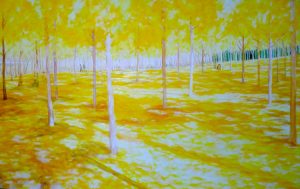
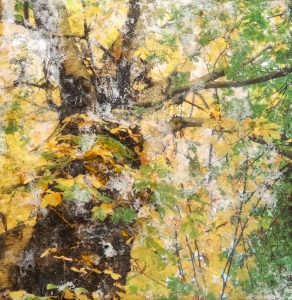
Second Beech- Mayfield ,sucrose series Niamh Cunningham 倪芙瑞莲 2019

简体中文

This weeks tree story is a personal one and perhaps a bit unusual. People often plant trees to remember a loved one who has passed but this story is about chopping down a tree (which had already died many years earlier ) as a kind of tribute to the memory of a loved one .

The Beech Tree

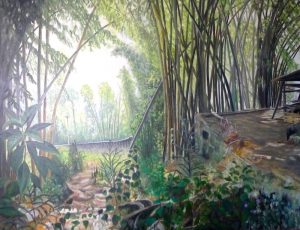
There were two copper beech trees in the garden where I grew up in Carlow Ireland. It is a big garden and my mother continues to tend to it today.   One was near the house and the second was among other trees in the back garden which features in the above artwork.  They shed years of dappled light on the ground where my seven siblings and I played and fought, mended bikes and canoes. I had a privileged childhood.  Many years later one of the beech trees near the house had died,  a cable TV company nailed electric wires multiple times into the bark over several years. We were not customers of this company and did not use or pay for this TV service but they wanted the wire to cross the garden to the next house as it was cheaper than bringing the wire back to the road. A few years later the bark had swallowed the wire , the cable company came to nail new wires , three separate wires were swallowed by the bark and the tree eventually died. The dead tree soared 20 metres  high and threatened to come down crashing down on the house during stormy weather. But the TV company refused to remove their wires.  


The Accidental Academic

My father was ‘an accidental academic’, he remained in school instead of the family farm because of his love for sports – gaelic football and hurling ( hurling is a very fast Irish field sport using a long wooden stick and hard small leather ball) . He also happened to be smart and gained a number of scholarships and later became an award-winning scientist.  He discovered the mode of soil fungal infection in cereals and which he had named ‘Take All’ and had independent articles published Nature in the early 1970’s. A moral and self-disciplined man he conducted matters fairly and always abided by the law. He wrote to the TV company, he got his solicitors to present their letters to the multinational corporation to explain how he needed to cut the dead tree down as it threatened to fall crashing down on the house. The dead beech killed by the wires could no longer be used as a telegraph pole. These letters continued with no response. A few years later my beloved father passed away. All my brothers and sisters were home for the funeral. After contemplating the dead tree we knew we could do this one strange thing to honour Colm Patrick Cunningham (1933-2003). 

There would be no more waiting, we would cut the tree down . No more letters, no  advance warning, no more feeling guilty of the neighbours TV service disrupted , we were going to do this ……. And we did.  


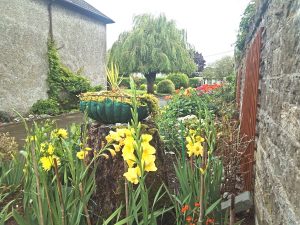
Beech one as flowerpot stand

Memory Palace of Trees 2020 is an ecological art practice which invites your participation to tell a story (or give some kind of information) about trees. It is a social enquiry of how to live better with the planet and with people by simply sharing stories. You are cordially invited to tell me your story of a tree or trees. (email : niamh@niamhcunningham.com) I would love to hear from you. Each week throughout 2020 a story will be posted with either an artwork already made or perhaps your story will inspire me to make a new work!


Week 16 Swan Goose forest

简体中文

Delighted this week to have a story from the artist Wu YiQiang吴以强 on a Tree planting project. 

Week 16. Swan Goose Forest oil on canvas 90x 240cm Niamh Cunningham 倪芙瑞莲2020

In 2008, Dongying Art District Beijing I often watched flocks of swan geese flying overhead and alongside this horizon were “lofty aspirations ” of the North drifting artists. In September of the same year the financial crisis swept the globe and since then only the sparrows have been chirping with no swan geese taking to the air.

Perhaps it was due to the heavy haze, maybe it was too hard a struggle to survive. I would like to believe that there are still a large number of swan geese in different habitats   thriving and breeding and that they have changed their flight routes from south to north. There are too many factories in Henan and Hebei. They object to the battalions of chimney stacks lined up with their hateful acrid fumes. These negative environmental markers forced the geese off route.

If you attempt to research these geese online using we chat, it is embarrassing that most results are about how to cook swan geese, introducing braised swan goose in brown sauce , yellow braised geese, the most delicious geese signature dishes! My eyes are lowered, food culture is a twisted evil ! It would appear that too many swan geese bore gifts of so much hope, alas they were all consumed by the diners!

Continue reading

Week 15 Roots of Recovery

简体中文

With little or no new cases it seems we are finally approaching the beginning stage of tentative recovery.

Happy Easter.

Keep well Keep Safe Keep Strong.


This weeks story comes from Carissa Welton . She is an environmental educator and founder of eco minded arts collective, Greening the Beige, that ran in China from 2007 – 2017. Currently she is working on a climate fiction (Cli-Fi) short story series for children.

Sea Blanket sucrose , mixed media, 34x 50 cm Niamh Cunningham 倪芙瑞莲2018

My hometown is Ann Arbor, (Michigan US) which is also affectionately known as ‘Treetown’. The first village in 1824 was named Annarbour. It was named after the early settlers’ wives (both named Anne). However the native tribes called it Kawgeeshkawnick which ironically means “saw drilling place”.


I was thinking about the irony of the term ‘Treehugger’

There is evidence to show that spending time with plants and trees generate immense health benefits such as lower cortisol levels, lower pulse rate and blood pressure. There are specific studies of how trees have helped people with mental illness, ADHD, depression and headaches (Blinded By Science, Matthew Silverstone)


Not only that but the research journal ‘Environmental Pollution’ found that trees prevented 850 human deaths and 670,000 cases of acute respiratory symptoms in 2010 alone. That was due to the tree leaves absorbing harmful gases and blocking particulate matter, resulting in the removal of 17 tonnes of air pollution.

The Japanese have practiced “forest bathing” (shinrin-yoku). There is a book by Dr Qing Li that explains the scientific reasons that trees benefit human health.

Aroma of the forest..

Plants and trees emit substances which help protect themselves from harmful insects and germs. Studies of these  phytoncides have been found to  which increase white blood cell production supporting the immune system.


Memory Palace of Trees 2020 is an ecological art practice which invites your participation to tell a story (or give some kind of information) about trees. It is a social enquiry of how to live better with the planet and with people. You are cordially invited to tell me your story of a tree or trees. (email : niamh@niamhcunningham.com) I would love to hear from you . Each week throughout 2020 a story will be posted with either an artwork already made or perhaps your story will inspire me to make a new work!

Week 14 Elves of the Plateau and Corridor Forests

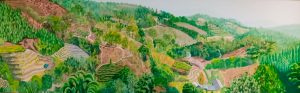
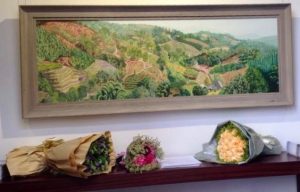
Yunnan panorama 150 x 50 cm Niamh Cunningham 倪芙瑞莲 2014

简体中文

On the edge of the Yunling Mountain forest,  Dali,  Yunnan, there is a family of 150 golden snub-nosed monkeys. Across this forest to the south, there is smaller community of  20 monkeys . The two groups of monkeys were originally a family, but were trapped on two  ” forest islands” separated by a human development. If the two monkey populations continue to be isolated, a likely outcome includes inbreeding, reduction in genetic diversity  and increased risk of extinction of the Yunnan golden monkey.  

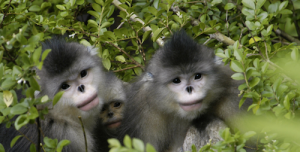
Yunnan Golden snub noses Monkeys photo credit The Nature Conservancy 

The Yunnan Golden Monkey also called the black and white snub nosed monkey because of an evolutionary curiosity of missing nasal bones . The pug nosed primate has other special features of bright red lips which is a status symbol for high ranking males.

The Yunnan snub – nosed monkey is one of 25 most emdangered primates in the world. It is unique to China with more than 3,000 scattered in Tibet and Yunnan. Due to their extremely high altitude habitat , their very existence is a marker for biodiversity. The forest that attracts them provides shelter for other rare animals and plants .


The corridor of trees planted to connect the forest islands include Huashan Pine and Spruce. At high altitudes spruce which is resistant to dry and cold climates is unusual for its longetivity living beyond millenia. At low altitudes the spruce is planted with Chinese Huashan pine , this pine is native to China which conserves water and prevents wind erosion.  


There is a new protection network bringing government protection management agencies, conservation groups like TNC (The Nature Conservancy) , Ant Forest,  social welfare organizations and scientific research institutions. Combined these agencies will monitor monkey populations and habitat health, establish a patrol system to prevent poaching and illegal logging,  restore and reconnect the increasingly patchy landscape. The partners will also educate local communities about conservation and lead community development. Protecting the golden monkey will benefit many other plants and animals across the entire ecosystem.


Note: Ant Forest is an Alipay mobile App and is recognized for inspiring consumers to reduce their carbon footprint , resulting in China’s largest private sector tree planting initiative. It was awarded the UN’s highest environmental honour Champions of the Earth award 2019 .

If you have experience using the Ant Forest app I would love to hear from you . I hope to write separate blog on Ant Forest in the coming weeks .


Link 1 Alipay mobile  app

Link 2 Nature Org 


I would like to thank Zhao Mingshi of the Nature Conservancy(TNC)  ( Forest Carbon) for directing me to the above  story.  


Memory Palace of Trees 2020 is an ecological art practice which invites your participation to tell a story (or give some kind of information) about trees. It is a social enquiry of how to live better with the planet and with people. You are cordially invited to tell me your story of a tree or trees. (email : niamh@niamhcunningham.com) I would love to hear from you . Each week throughout 2020 a story will be posted with either an artwork already made or perhaps your story will inspire me to make a new work!

Week 13 Trees can communicate

Barrow Trance  130x 160cm Niamh Cunningham芙倪瑞莲2020  

简体中文

“We found that trees could communicate, over the air and through their roots. Common sense hooted us down. We found that trees take care of each other. Collective science dismissed the idea. Outsiders discovered how seeds remember the seasons of their childhood and set buds accordingly. Outsiders discovered that trees sense the presence of other nearby life. That a tree learns to save water. That trees feed their young and synchronize their masts and bank resources and warn kin and send out signals to wasps to come and save them from attacks. “Here’s a little outsider information, and you can wait for it to be confirmed. A forest knows things. They wire themselves up underground. There are brains down there, ones our own brains aren’t shaped to see. Root plasticity, solving problems and making decisions. Fungal synapses. What else do you want to call it? Link enough trees together, and a forest grows aware.”
― Richard Powers, The Overstory


Memory Palace of Trees 2020 is an ecological art practice which invites your participation to tell a story (or give some kind of information) about trees. It is a social enquiry of how to live better with the planet and with people. You are cordially invited to tell me your story of a tree or trees. (email : niamh@niamhcunningham.com) I would love to hear from you . Each week throughout 2020 a story will be posted with either an artwork already made or perhaps your story will inspire me to make a new work! 

Week 12 Park Tree

week 12 Chestnut -sucrose series 50×50 cm Niamh Cunningham 倪芙瑞莲 2020

简体中文

The Tree Story for week 12 features a poem my friend Prof Fu Hao . Keep Well , Keep Safe , Keep Happy .

A TREE IN THE PARK


Tree in the park, what

are you waiting for?


We don’t know when you were transplanted here

but only see you’ve never moved since,

for your feet have already degenerated.

you’re unable to walk as you will.


You can no longer remember

your family tree,

that majestical multitude dancing in winds and storms,

but stand alone at a loss

in the very centre of the crowded city.


In summer you wear thick clothes

and in winter strip off

and mumble to yourself under the midnight moonlight

like a homeless lunatic beggar

for whom nobody cares,


till one day someone who loves someone

leaves with you a heart pierced by an arrow.

The deep cuts will never cicatrize.

Time is a bad healer,

who can only make the wounds gape open

like chapped skin.


Some years later, on your old trunk

they might nail a board with these words written:

“Once upon a time a hero pursued his enemy,

who ran around the tree here.

and with his bow shot and missed,

leaving these cuts in the tree.”


Tree in the park, what

are you waiting for?


 Fu Hao 1991


Memory Palace of Trees 2020 is an ecological art practice which invites your participation to tell a story (or give some kind of information) about trees. It is a social enquiry of how to live better with the planet and with people. You are cordially invited to tell me your story of a tree or trees. (email : niamh@niamhcunningham.com) I would love to hear from you . Each week throughout 2020 a story will be posted with either an artwork already made or perhaps your story will inspire me to make a new work! 

Week 11 Of Bamboo and Birds


Yunnan Bamboo Oil on Canvas150x115cm Niamh Cunningham 倪芙瑞莲 2014

简体中文

Yesterday, I saw a dramatic display of  mandarin ducks in flight. Many  Mandarin Ducks choose to spend winter in Beijing,  some  perch in nests near  the staff residential area for the Environmental Protection and Greening Bureau.

     On the campus, there are two bamboo forests of which I am very fond.  One is in front of the catering college. The tall bamboo stalks are dense, and not easily visible. It is a paradise for many small birds (including larger birds)- birds of Paradise so to speak. The second is a small bamboo forest between buildings 7 and 6 where the kittens often hide and play where I have also witnessed little hedgehogs foraging at night.

Continue reading

Week 10 Frozen Fruit

Frozen Fruit: digital print , size variable, Niamh Cunningham 倪芙瑞莲 2020

简体中文

‘My tree story comes from childhood memories in my hometown in Inner Mongolia. Back then there were relatively few winter fruits. The happiest times were when my young friends and I would feast on sea- buckthorn berries which had been frozen in the snow.’

If sea buckthorn berries are not frozen it is near to impossible to pick these bright orange tiny pumpkins, apart from the long razor-sharp thorns the berries hold on tight to the branch and have a very thin skin so the tug you need to free them squishes them to a pulp.

雪甜  March 2020

Continue reading